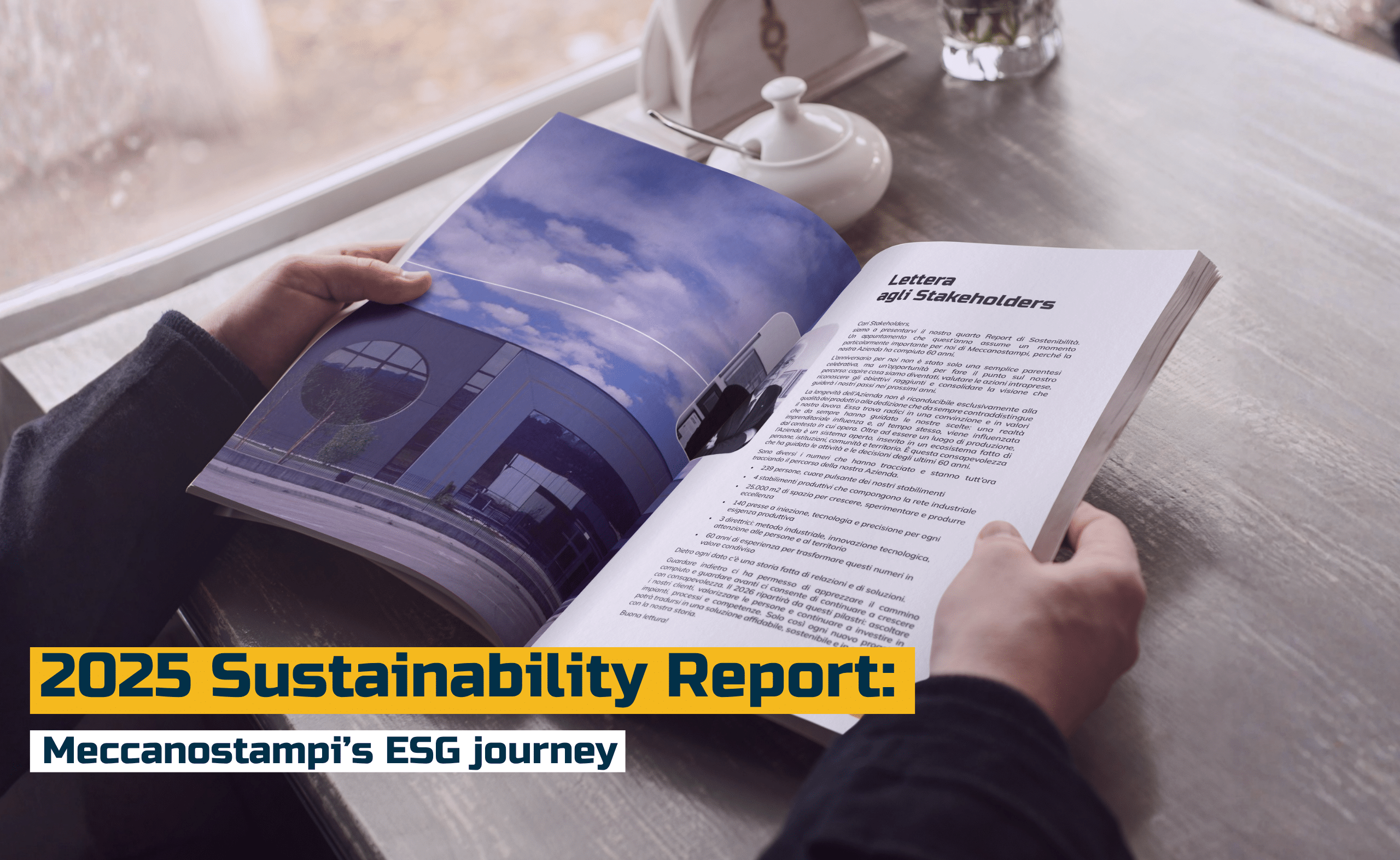
Meccanostampi presents its 2025 Sustainability Report, the fourth report detailing its environmental, social, and governance initiatives.
The document comes at a significant time for the company: 2025 marked the 60th anniversary of Meccanostampi, which was founded in 1965 in Limana as a workshop specializing in the manufacture of precision molds. This milestone allows us to gain a deeper appreciation of the continuity of an industrial approach that has been developed over time.
Today, Meccanostampi is a company with over 250 employees, 4 production facilities, 25,000 m² of floor space, and 140 injection molding machines. These figures reflect a complex organizational structure and a clear responsibility: to produce technical plastic components reliably, efficiently, and in a manner consistent with the expectations of customers, employees, the local community, and the supply chain.
The 2025 Sustainability Report stems from this need: to measure results, ensure transparency in decision-making, and transform data into a useful tool for guiding improvement.
Sixty Years in Business: A Legacy to Be Accounted For
Sixty years in business mean a constantly evolving market, technology, organization, and expertise.
For Meccanostampi, this continuity has been built through investments, long-term relationships, and the ability to adapt. From mold design and construction to injection molding, and on to assembly and quality control, the company has developed an integrated supply chain capable of supporting the customer from the design phase through to the finished product.
In Meccanostampi’s industrial history, its 60th anniversary serves as a starting point for examining what the company is today: a development partner with expertise spanning the entire process.
The Sustainability Report follows this same approach. It provides a snapshot of how Meccanostampi manages its responsibilities: toward the environment, toward people, toward the local community, and toward the quality of its processes.
A report that starts with the data and moves on to the methodology.
Investments, Efficiency, and Reducing Environmental Impact
In 2025, Meccanostampi continued to invest in solutions aimed atimproving production efficiency and reducing its environmental impact.
Among the key initiatives are the new photovoltaic system, representing a total investment of 862,000 euros, and the introduction of electric presses, valued at 368,000 euros. These are two complementary initiatives: on the one hand, the production of energy from renewable sources; on the other, the improvement of efficiency in the stamping processes.
In a manufacturing company, however, environmental sustainability also depends on monitoring energy consumption, using more efficient technologies, reducing waste, and continuously monitoring process data.
The 2025 Financial Statements also show an improvementin carbon intensity per revenue, which fell from 0.65 kgCO₂/€ in 2024 to 0.50 kgCO₂/€ in 2025. This figure indicates greater environmental efficiency and confirms the direction the company has taken—namely, maintaining strong industrial performance while reducing the environmental impact associated with its business activities.
Sustainability thus becomes an integral part of the production process. Energy, materials, machinery, planning, maintenance, monitoring, and quality all contribute to the same goal: to produce better, more efficiently, and with a more responsible approach to resources.
People, Safety, and Skills
The sustainable growth of an industrial company depends on its facilities, technologies, and, above all, its people.
In 2025, Meccanostampi continued to invest in training, safety, employee engagement, and well-being. Training played a central role here: over the course of the year, an average of 31.07 hours of training per employee was provided, exceeding the minimum target of 24 hours per year.
Specifically, the training programs focused on technical, digital, and soft skills, with an emphasis on topics related to energy efficiency, waste management, cybersecurity, and the responsible use of artificial intelligence in the workplace.
In the areas of health, safety, and the environment, Meccanostampi operates through an Integrated Management System that complies with ISO 45001 and ISO 14001 certifications. These tools provide an operational foundation for monitoring risks, improving working conditions, and maintaining a structured approach to prevention.
Meccanostampi’s approach to safety and sustainability highlights the value of certifications as part of a system of continuous improvement. In the 2025 Annual Report, people are identified as one of the key factors that enable the company to maintain quality, precision, and reliability over time.
Governance and Accountability
In 2025, the generational transition on the Board of Directors also formally took effect, with the aim of ensuring business continuity and preserving the identity that has guided Meccanostampi’s development over time.
ESG governance is supported by an in-house ESG Manager, who is responsible for coordinating and monitoring environmental, social, and organizational initiatives. This is complemented by oversight tools such as the Code of Ethics, Model 231, whistleblowing channels, the Legality Rating, and periodic monitoring of operational, environmental, and ethical KPIs.
Cybersecurity also falls within the scope of corporate responsibility. Data protection, the continuity of information systems, and digital risk management are increasingly important aspects for a company operating in technical and international supply chains.
Managing sustainability means giving structure to commitments: defining roles, measuring indicators, verifying results, and integrating ESG information into business decisions.
Region and Supply Chain
Meccanostampi is based in Limana, in the province of Belluno, where its four plants form an integrated industrial complex.
This configuration allows us to keep expertise, technology, and people close together, fostering more effective process control and faster decision-making. It is also a concrete way to foster continuity in the local area: employment, expertise, relationships with suppliers, collaboration with local organizations, and a commitment to the community.
For Meccanostampi, sustainability also encompasses this aspect. Being part of a community means contributing to its growth through production, education, health, prevention, and the well-being of the community.
At the same time, the report highlights how central the supply chain is to the ESG journey. A significant portion of the overall carbon footprint is linked to Scope 3—that is, indirect emissions along the value chain. For this reason, improvement requires ongoing efforts regarding materials, logistics, supply chains, and collaboration methods.
Measure to Improve
In conclusion: the 2025 Sustainability Report is, first and foremost, a working tool.
It allows you to review what has been done, identify areas for improvement, and set new priorities. Reporting means taking responsibility for your results and building a stronger foundation for future decisions.
After 60 years in business, the journey continues with the same approach: measuring, improving, and building value over time.
A “quick note”: The 2025 Sustainability Report was prepared in accordance with the Basic Module and the Comprehensive Module set forth in the European voluntary standard VSME, developed by EFRAG and recommended by the European Commission. This approach allows for clear and comparable reporting, providing a structured overview of economic, environmental, and social performance.