The mold is not the starting point
In the development of a technical plastic component, the mold is often perceived as the center of the project. In reality, in more complex projects, the work begins much earlier.
It starts with the analysis of afunctional need, a geometry to be made manufacturable, a material to be evaluated, a tolerance to be guaranteed over time. It begins with the discussion between customer and industrial partner, when the product is not yet a final object but a set of constraints, possibilities, and decisions to be guided.
For Meccanostampi, developing a product means intervening in this initial phase with an integrated vision: not just building the mold, but contributing to the definition of a stable, efficient and repeatable production process. An approach that stems from an industrial history that began in 1965 and has grown over time to become a complete supply chain, from design to production: discover the history of Meccanostampi.
This is where design and process begin to grow together.
From requirement to manufacturability
Each technical component brings with it a set of demands: mechanical performance, strength, aesthetics, compatibility with other elements, production continuity, cost, volume, and expected quality.
Turning these requirements into an industrializable product requires reading and translation work. Indeed, a functionally correct geometry is not always immediately suitable for injection molding. Critical issues may arise related to thicknesses, injection points, shrinkage, warpage, joint lines, extraction or material choice.
Therefore, the co-design phase is decisive.
Working together with the customer from the earliest stages enables early identification of critical points and intervention before the design becomes rigid. A geometric change evaluated at the beginning can avoid subsequent rework on the mold. A correct choice of material can make the process more stable. A different interpretation of the component can improve quality, cycle time and production reliability.
At this stage, the value is not only in the ability to propose solutions, but in the ability to bring function and production into dialogue.
Co-design, simulation and industrialization
Product development at Meccanostampi follows a progressive path, with each stage preparing for the next.
The initial feasibility analysis allows for evaluation of the component, identification of any critical issues, and sharing of the final technical specifications with the customer. From there, we move on to project validation, mold design and construction, initial functional testing, and molding process commissioning.
Simulation plays an important role in this path, because it allows anticipating the behavior of the material inside the mold and evaluating aspects that will have a direct impact on part quality and production stability. It is not an isolated step, but a tool to support design and industrial decisions.
Industrializing a product means just that: turning a technical solution into a concrete, verifiable and repeatable process. It means considering not only the finished component, but everything needed to produce it correctly over time: mold, press, automation, controls, cycles, maintenance, flows and acceptance criteria.
In this view, the process does not come after the project. It is part of it.
Validate means to make stable
Validation is when design assumptions are compared with production reality.
After the initial inspection, the component is analyzed from a dimensional, functional and aesthetic point of view. Samples allow verification of compliance with specifications and identification of any corrective actions on the mold or process.
At Meccanostampi, this activity is supported by the Metrology Laboratory, where technologies such as tomography, probing or optical CMM and three-dimensional optical scanning enable accurate and shareable data. In this way, the measurement report becomes a working tool: it documents the results, makes the comparison with the customer transparent, and allows any fine-tuning to be guided.
Quality, in this sense, is not a final control. It is a condition that is built all along the way.
A necessary approach in complex products
This method becomes even more relevant when the component hashigh technical complexity.
This is the case for bi-material products, functional components for high-tech industries, automotive applications, or projects requiring large production volumes. In these contexts, every design choice has direct consequences on the process: the positioning of an injection point, compatibility between materials, rotational behavior within the mold, surface quality, cavity stability, and in-line control of critical features.
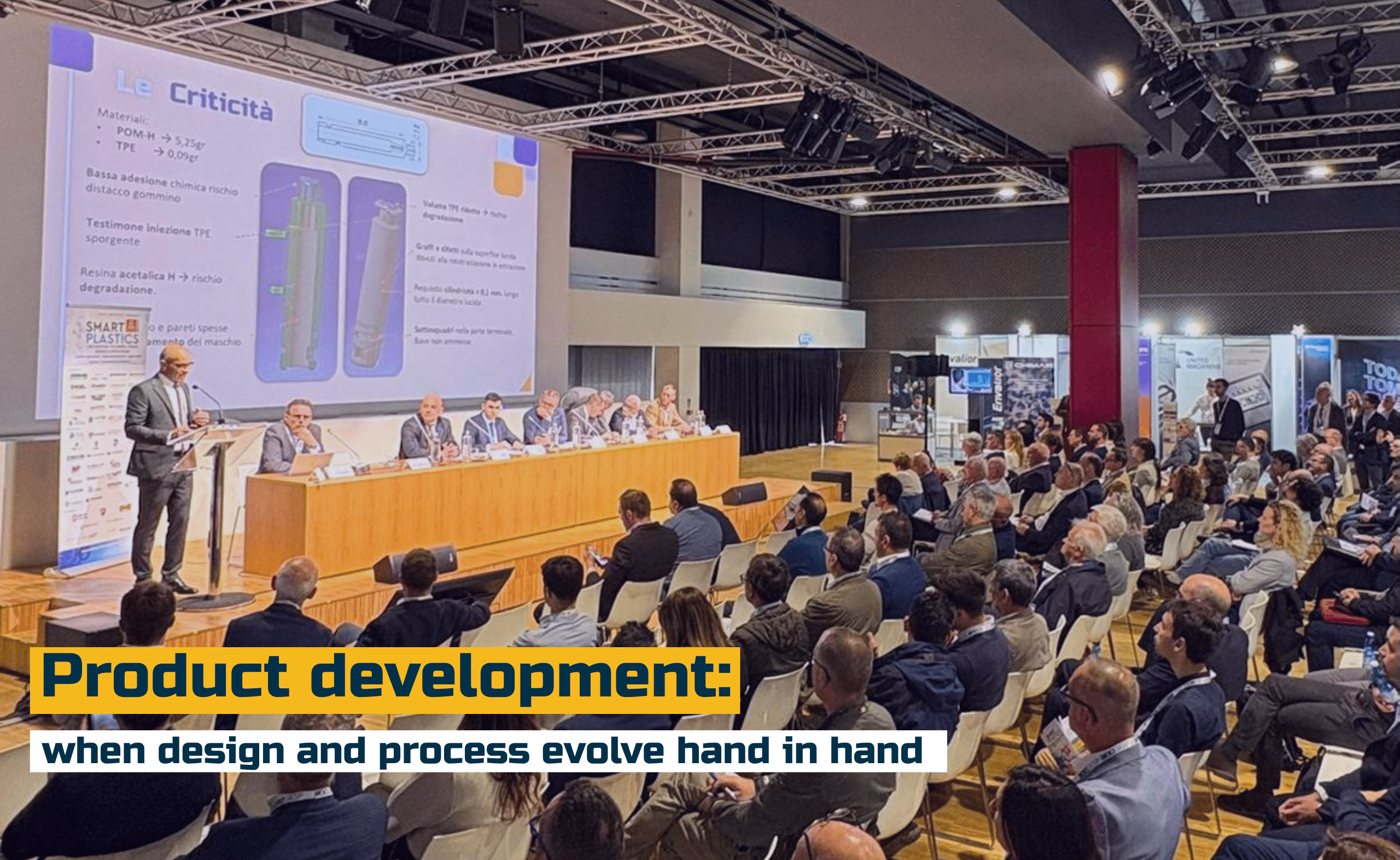
During Smart Plastics 2026, Roberto Menichetti talked about a case study developed together with EWIKON and the customer Cebi Italy: a 16+16-cavity rotary table mold for a bi-material automotive component, with a production capacity of about 7 million parts per year. A project in which the collaboration between the customer, Meccanostampi and the technological partner allowed to address critical issues related to materials, geometries, injection, quality and production repeatability.
In such an application, it is not enough to build a high-performance mold. It is necessary to design a consistent production system: capable of keeping the component compliant, controlling critical features, and ensuring stability over time.
The value of a development partner
The development of a technical product is not a linear sequence of separate activities. It is a path in which each skill influences the others.
Design dialogues with mold making. Simulation guides industrial choices. Testing and dimensional surveys return useful data for fine-tuning. Automation and quality control contribute to process stability. Manufacturing provides concrete directions for improving efficiency, continuity and reliability.
This integration also requires solid planning: in complex projects, time, resources and priorities must be governed methodically, to transform complexity into a controllable industrial process. This is the same principle that guides the evolution of production scheduling systems adopted by Meccanostampi, recounted in the article on how APS makes stamping timely and predictable.
That is why, in complex projects, the value of an industrial partner is measured not only in executive capacity, but in the ability to accompany the client throughout the entire product development.
It means entering the project before decisions are final. It means reading technical constraints and turning them into productive solutions. It means reducing risk, containing rework, improving development time and building a more robust process.
At Meccanostampi, product development stems from this integration.
Because a technical component is never just a shape to be printed. It is the result of a balance between function, material, process and control. A balance that must be designed from the beginning, when the product is still evolving and the process can grow with it.