When a company has to choose who to entrust with a mold or mass production, the initial questions are always the same: what material to use, what tolerances can be achieved, how much does it cost, when does the first sample arrive.
Less obvious-but much more strategic-is another point: what kind of partner am I choosing? Someone who “executes a design” or someone who helps build the solution?
At Meccanostampi we start exactly from here. Our work is not limited to designing a mold or running a press: it is based on a method, made up of co-design, technical rigor, and industrial capacity, that leads us to stand by the customer from the first idea to the finished part.
From 3D file to finished product: a single path, not separate stages
Often, in the production chain, the stages are broken up: one supplier is in charge of the mold, another of the molding, another of the assembly.
The result is that, when something doesn’t work, it becomes complicated to figure out where the critical issue has arisen.
The Meccanostampi model was created precisely to avoid this “silo” effect: we take care of everything from design to finished product. The typical path of a project goes from listening to the needs and application context, feasibility analysis and co-design with the customer, in-house mold design and construction, to injection molding with automated equipment, quality control, and, when needed, assembly and finishing stages.
They are not watertight compartments. They are stages in the same story, followed by teams talking to each other and looking toward the same goal: to transform a requirement into an industrializable, repeatable, reliable component.
Co-design: not only “can it be done,” but “how it pays to do it”
Where our method makes the most difference is probably at the beginning. When a new project arrives, we don’t just check to see if it “works” -we get into the merits of the choices.
This means discussing geometries, thicknesses, injection points, extraction, parting lines together; evaluating how the mold will perform in molding and the part in operation; and reasoning about the relationship between aesthetics, functionality, and productivity. In many cases, proposing small changes at the design stage avoids major problems in production.
Co-design, for us, is this: using expertise on molds, processes, and engineering plastics to reduce risk and turn a theoretically correct design into a component that actually works, throughout its life cycle.
Innovation yes, but with feet in the department
When we talk about innovation, it is easy to stop at the words: Industry 4.0, digital, data. At Meccanostampi we try to measure each choice with a simple question: what can concretely improve a mold, production, and the part?
Filling simulations, data analysis, in-line control systems, custom automations, 3D printing gripping hands-these are tools we have incorporated into the workflow only when they have proven to bring a real, measurable benefit on the process.
We are not interested in “having the technology” itself. We care about that technology helping us to:
- Making processes more stable
- reduce waste
- Shorten the time between sampling and series
- Increase repeatability between different batches, cavities, molds
Innovating, for us, means taking this step forward while maintaining a healthy balance between scientific rigor and industrial pragmatism, consistent with our working method.
Quality as a shared language
Those who work in industries such as automotive, electromechanical, electronics, or lighting know that quality is not just an entry at the end of the bill of materials. It is a shared language of tolerances, control plans, reports, capabilities, that must be understood equally by designers, buyers, and quality engineers.
The relationship with partners goes precisely in this direction: using internationally recognized tools and methods to ensure that “compliant piece” is not an opinion, but a measured, documented, repeatable fact.
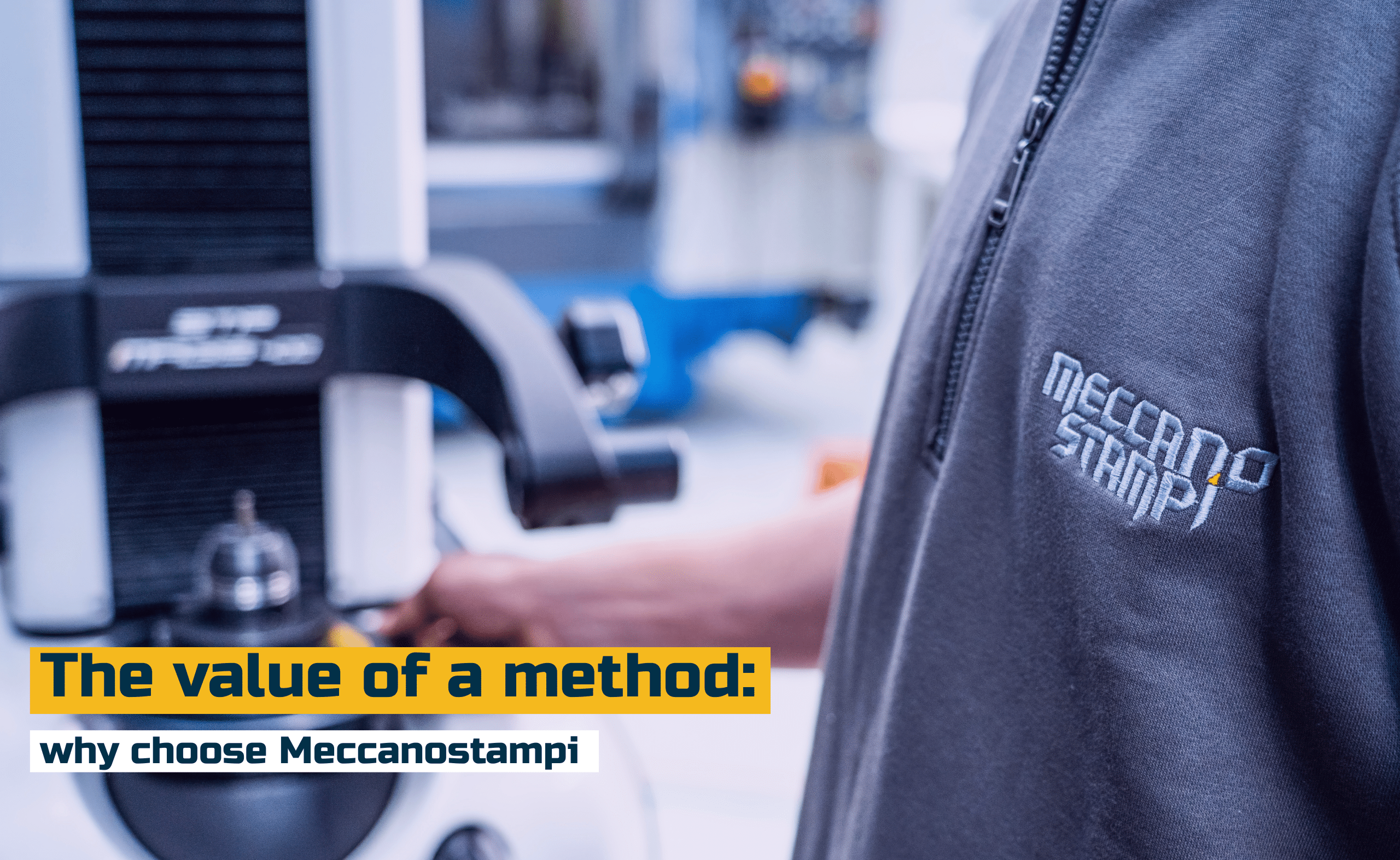
The metrology room is not a separate department: it dialogues with design, with those who make the molds, and with those who run the presses. Every meaningful measurement becomes useful information to better calibrate processes and equipment.
System certifications-IATF 16949, ISO 9001, ISO 14001, ISO 45001-are, finally, the context that obliges us, every day, to translate this language into procedures, controls, evidence.
Planning and reliability: the delivery date is not a number on the Gantt
There is another aspect of the method that is often underestimated: planning. Building a mold or starting a series is not only about getting the parts right, but also about getting them done in the agreed-upon time frame.
So we have worked a lot on scheduling activities, both in tooling and molding, with tools that cross-reference actual capacity, workloads, maintenance, and material availability. The delivery date is the result of a plan that takes into account the actual resources and priorities of all the jobs.
It is work that the customer often does not see, but they feel the effects: fewer surprises, less chasing, more opportunity to build in turn production plans and product launches with a lower risk margin.
The heart of our method
Putting all these dimensions together-co-design, process integration, pragmatic innovation, measurable quality, planning-is how Meccanostampi has chosen to be in the marketplace.
That, in the end, is the heart of our method: taking each component seriously, because inside that component is a part of the trust a customer has given us, and returning that trust in the form of solutions that work, today and over time.